
NBA Betting UK vs US: Analyzing Market Differences
 Available in US
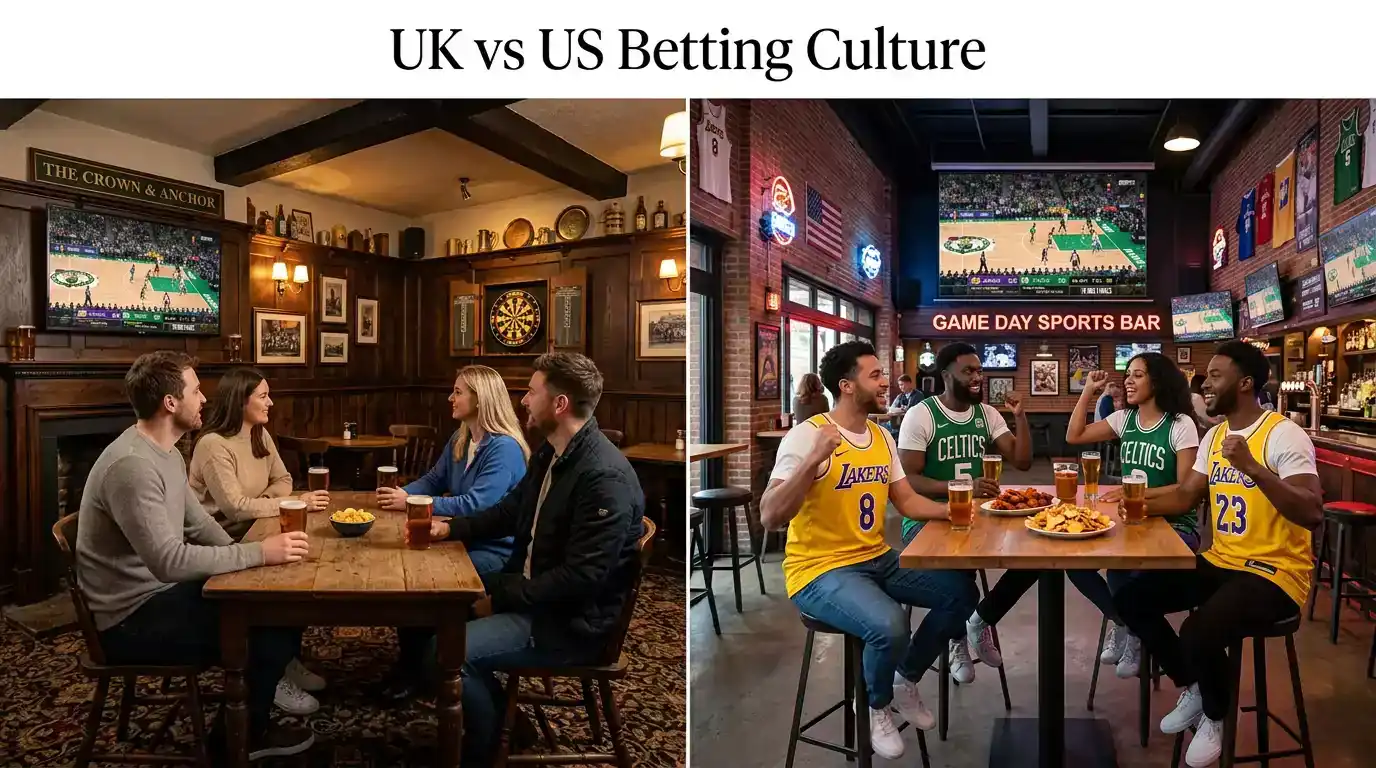
Comparing Sportsbook Prop Availability in the UK vs US
I spent a week in Las Vegas two seasons ago, placing NBA bets alongside American sharps, and the experience was disorienting. The odds looked different, the terminology was different, the regulatory environment was different, and the market dynamics operated on assumptions I had spent years unlearning as a UK bettor. The NBA is the same league in both countries, but the betting infrastructure wrapping around it produces two meaningfully different experiences. Understanding those differences makes you a better bettor in your own market, because it reveals which advantages are structural to your geography and which are universal to the sport.
US sports betting revenue reached $16.96 billion in 2025, with a total handle of $166.94 billion — staggering figures that dwarf the UK’s approximately GBP 2.48 billion in sports betting gross gambling yield. That volume gap shapes everything from market liquidity to odds efficiency, and it has direct implications for how NBA prop lines are set, how quickly they move, and where value tends to cluster on each side of the Atlantic.
Regulatory Frameworks: UKGC vs State-by-State US Licensing
The UK operates under a single national regulator — the Gambling Commission — with one set of rules, one licensing framework, and one complaints process. Every operator serving UK customers holds the same type of licence, meets the same compliance standards, and faces the same enforcement regime. That uniformity creates a level playing field for bettors: the rules are consistent regardless of which platform you use.
The US has no equivalent. Since the Supreme Court struck down the federal ban on sports betting in 2018, legalisation has proceeded state by state. As of 2026, sports betting is legal in 38 states plus Washington DC, but each state has its own regulatory body, its own rules, and its own tax regime. Americans have collectively wagered more than $600 billion since legalisation, and operators have earned more than $50 billion. But the state-by-state patchwork creates inconsistencies in market access, product availability and consumer protection that UK bettors do not face.
NBA Commissioner Adam Silver has publicly called for federal legislation, arguing that the fragmented system needs to be replaced by uniform regulation. AGA president Bill Miller has countered that sports betting belongs under state and tribal regulation, calling it the mechanism through which consumers are protected and communities share in the benefits. That debate is unresolved, and its outcome will shape the US betting landscape for the next decade. For UK bettors, the relevance is indirect but real: the regulatory fragmentation in the US means that some prop markets available in one American state are restricted in another, while the UK’s unified framework ensures that market availability is consistent nationally.
The Gambling Commission’s enforcement posture is notably more aggressive than most US state regulators. The Commission carried out roughly 9,700 compliance actions in 2024/25, more than doubling the prior year. That intensity reflects a regulatory philosophy where consumer protection is actively enforced rather than passively monitored. UK bettors benefit from this through stronger funds protection, mandatory responsible-gambling tools, and a formal complaints process that, while imperfect, provides recourse that bettors in many US states lack.
Odds Formats, Taxation and Payout Structures
The most visible difference between UK and US NBA betting is how the odds are displayed. UK sportsbooks default to fractional odds: 5/1, 10/11, 4/6. US sportsbooks use American odds: +500, -110, -150. The two formats convey the same information but require different mental arithmetic. I have become fluent in both through necessity, but for a UK bettor who exclusively uses fractional or decimal formats, encountering American odds on a US-facing analysis site or tipster service can be confusing.
The conversion is mechanical. American odds of -110 are equivalent to fractional 10/11 (or decimal 1.909). American +200 equals fractional 2/1 (or decimal 3.00). The important insight is not the conversion itself but the convention: American odds are centred around a $100 reference point (what you need to bet to win $100 on a favourite, or what you win on a $100 underdog bet), while UK odds express the profit-to-stake ratio directly. Neither format is inherently better, but the fractional format is more intuitive for quickly assessing the bookmaker’s implied probability.
Taxation is the structural gap that matters most for net returns. The Remote Gaming Duty in the UK rose to 40% in April 2026, but the duty is levied on the operator, not the bettor. UK gambling winnings are entirely tax-free. In the US, gambling winnings are taxable income at both federal and state levels. A US bettor winning $10,000 on an NBA futures bet might pay $2,500-$3,700 in combined taxes before touching the money. A UK bettor winning the equivalent keeps every penny. Over a season of active betting, that tax differential compounds into a significant advantage for the UK bettor’s net bankroll growth.
Prop Market Availability and Depth
This is where the US market holds a clear advantage — for now. The sheer volume of American NBA betting demand drives deeper prop coverage across more platforms. US sportsbooks routinely offer 80 to 100 individual player prop markets per game, including exotic props like “first to score 10 points,” “player to record a triple-double,” and same-game-parlay-specific selections that do not exist as standalone markets. UK sportsbooks typically offer 40 to 60 props per game on marquee matchups, dropping to 20 to 30 on mid-week games.
The NBA’s response to the October 2025 integrity crisis included asking partner bookmakers to restrict certain prop bets, particularly under props on two-way contract players. That restriction has been implemented more aggressively on US platforms, where the indictment originated, than on UK platforms. However, UK sportsbooks connected to the NBA’s integrity monitoring infrastructure have also pulled some markets. The net effect is a slight narrowing of prop availability on both sides of the Atlantic, with the US experiencing a larger reduction from a higher baseline.
The depth gap is narrowing as UK operator interest in NBA grows. The NBA’s $76 billion media deal ensures global broadcast penetration, and the league’s deliberate international strategy — including regular-season games in London and Paris — is building UK fan engagement that feeds directly into betting demand. As demand grows, UK operators have a commercial incentive to deepen their NBA prop menus to capture that volume. I have seen measurable improvement in UK NBA prop coverage over the past three seasons, and I expect the trend to continue.
For UK bettors, the practical takeaway is this: you are operating in a market that is structurally favourable on taxation and regulation but slightly less favourable on prop depth and market liquidity compared to the US. The edges available to you cluster in different places than the edges available to an American bettor, and your strategy should reflect that. Focus on the prop markets that your UK platforms cover well, use the tax advantage to compound your net returns, and leverage the consistent regulatory environment to maintain accounts across multiple operators for line shopping. That combination of geographic advantages is what makes the UK one of the strongest positions from which to bet NBA, as the broader NBA betting odds guide explores in detail.
Why do UK and US sportsbooks display NBA odds differently?
UK sportsbooks default to fractional odds, which express the profit-to-stake ratio directly. US sportsbooks use American odds, which are centred around a $100 reference point. The two formats convey the same probability information and can be converted between each other mathematically. Most UK platforms allow you to toggle between fractional, decimal and American formats in settings.
Do UK punters have access to the same NBA prop markets as US bettors?
UK sportsbooks typically offer fewer NBA player prop markets per game than their US counterparts — roughly 40-60 on marquee games versus 80-100 in the US. The gap is driven by lower NBA betting volume in the UK, which reduces the commercial incentive for operators to maintain deep prop menus. However, UK prop coverage is improving as NBA interest grows, and the core prop categories — points, rebounds, assists, threes, combos — are widely available across major UK platforms.
Prepared by the nba Player Betting editorial staff.