NBA Live Betting: Exploiting In-Play Prop Markets
 Available in US
- Timing Quarter-by-Quarter In-Play Prop Bets
- Foul Trouble and Blowout Protocols: Real-Time Signals
- Pace Shifts and Momentum Reads During Live Games
- The Latency Edge: Speed Differences Between UK Sportsbooks
- Cash-Out and Partial Cash-Out on NBA Live Bets
- Which Player Props Are Available In-Play on UK Platforms
- Emotional Discipline: Managing Tilt During Live Betting
- When Live Betting Adds Value and When It Destroys It
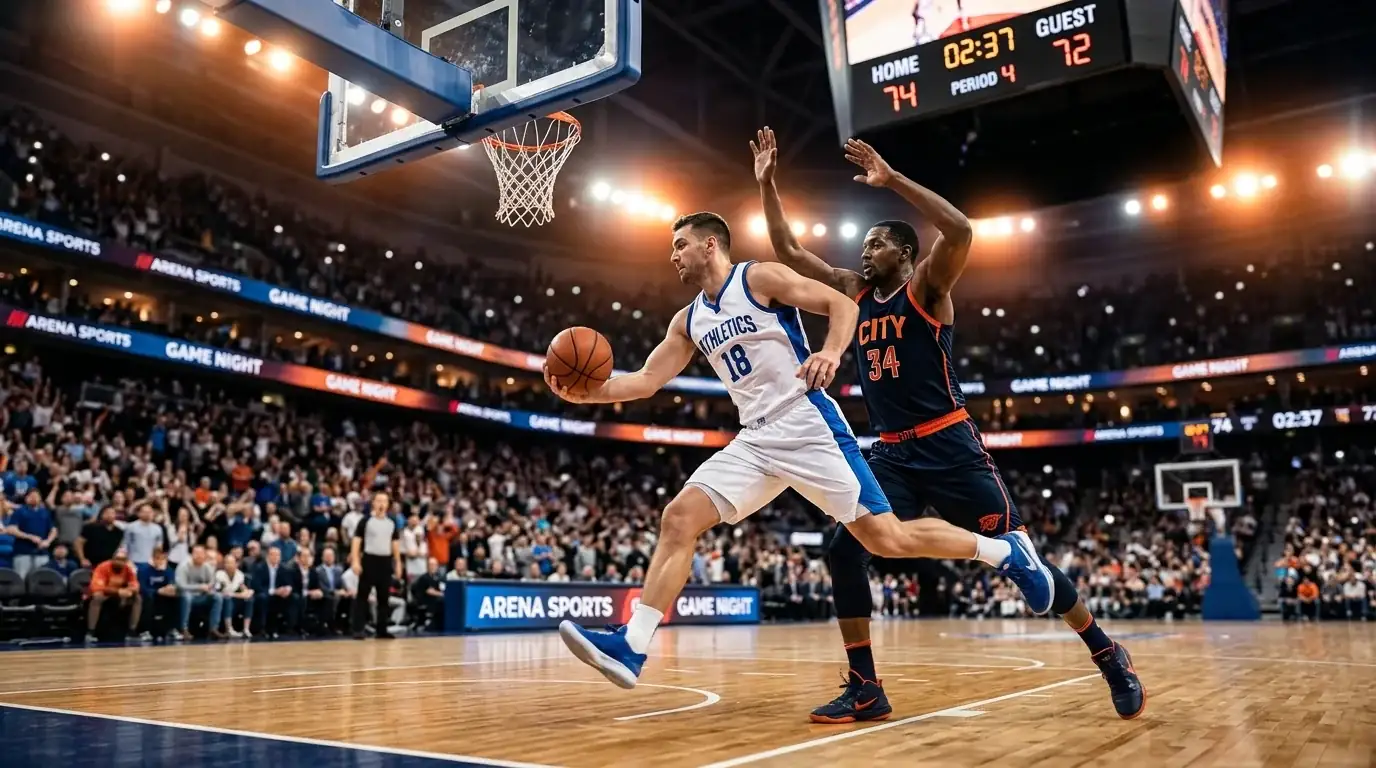
The first live NBA bet I ever placed was an over on a guard’s points prop at halftime. He had 14 points through two quarters, the live line sat at 26.5 for the full game, and I thought the over was automatic. He finished with 18. Foul trouble in the third quarter, a blowout in the fourth, and eight minutes on the bench watching garbage time. I learned more about live betting from that single loss than from a month of pre-game wagers.
Live NBA betting — in-play betting, in the UK vernacular — operates under fundamentally different dynamics than pre-game markets. The information landscape shifts in real time. Prop lines recalibrate after every possession. And the emotional intensity of watching a game while money is at stake compresses decision-making into windows of seconds rather than hours. Over 80% of sports bets in the US are now placed on mobile devices, and the proportion is climbing in the UK too, with 43% of bettors using phones as their primary device. That mobile-first reality makes live betting frictionless, which is both its appeal and its danger.
This guide covers the tactical framework I use for live NBA prop betting: when lines are weakest, what real-time signals to track, how latency differences between UK sportsbooks create opportunity, and — most importantly — how to maintain the discipline that separates a strategy from a gambling habit.
In-play momentum shifts often create lucrative opportunities in NBA quarter and half betting markets if you time your entries correctly.
Timing Quarter-by-Quarter In-Play Prop Bets
NBA games are not four identical 12-minute periods. Each quarter has a distinct character, and the live prop market reflects that unevenly — which means some quarters produce better betting opportunities than others.
The first quarter is chaos. Both teams are feeling out the game, coaches are testing defensive schemes, and individual player scoring is lumpy. A star who goes 0-for-4 from the field in the opening six minutes is not suddenly a bad player — he is working through an early-game rhythm that has nothing to do with his full-game projection. But the live prop line reacts to the box score, not to the context. A player whose pre-game points line was 24.5 might see the live full-game line drop to 20.5 after a scoreless first quarter. If your pre-game analysis told you 24.5 was fair, a live line of 20.5 after one bad quarter is a gift.
The second quarter is where rotations stabilise and the first meaningful data emerges. Bench units get their initial run, which tells you about the coaching staff’s trust in the rotation. If a backup point guard gets an extended run in the second quarter and the starter’s minutes dip, that is forward-looking information about the second half. The halftime line on a player prop is the most analytically useful live line of the game because it incorporates a full half of data — shooting efficiency, defensive matchup results, foul count, pace — and the sportsbook has had time to process all of it.
Third-quarter lines are where I find the most consistent value. The halftime break resets momentum, coaches make adjustments, and the sportsbook’s live model often lags behind those adjustments. A team that switches its defensive scheme at halftime — going from a drop coverage to a switching scheme, for instance — can dramatically alter a player’s scoring environment, but the live prop line may not reflect the change until the new scheme’s effects show up in the box score. That lag is your window.
Fourth-quarter live props are the trickiest. Blowouts collapse starters’ minutes. Close games extend them into overtime. Foul trouble removes players at unpredictable moments. The variance is extreme, and the sportsbook’s model handles it unevenly. I generally avoid initiating new live prop positions in the fourth quarter unless I have a very specific thesis about a player who is clearly going to play the full period — usually the star on the losing team in a close game who needs to score to keep his team alive.
Foul Trouble and Blowout Protocols: Real-Time Signals
Two fouls in the first quarter. That is the signal I watch for more than any other during a live NBA game. When a starter picks up two early fouls, the coach almost always benches him until at least the second quarter, sometimes longer. Those lost minutes directly compress the player’s statistical ceiling for the game. A starter who typically plays 34 minutes and scores 24 points might be capped at 26 minutes and 18 points if foul trouble costs him eight minutes of floor time. The live prop line drops, but the question is whether it drops enough.
The answer depends on the player’s role and the coach’s tendencies. Some coaches are aggressive about reinserting foul-plagued stars early in the second half, accepting the risk. Others are conservative, holding the player until the midpoint of the third quarter. If you have done your homework on coaching tendencies — and tracking this is straightforward, since rotation patterns are publicly available — you can identify whether the live prop has overreacted or underreacted to the foul situation.
Blowouts are the other major real-time signal. When the margin reaches 20+ points in the third quarter, most coaches pull their starters. The starters’ prop ceilings are locked at whatever they have accumulated, with no fourth-quarter runway to push higher. This kills overs. It also creates a less obvious opportunity: if the blowout is reversed — if the trailing team mounts a comeback and the lead shrinks below 10 — the starters re-enter and get extended run. Comebacks in the NBA are common enough that a fourth-quarter lead of 15 is not the certainty the live market sometimes prices it as.
I track both signals on a simple mental checklist during every game I am betting live: foul count for key players, and margin at the end of each quarter. These two data points alone filter out the majority of bad live prop bets I would otherwise make on impulse.
Pace Shifts and Momentum Reads During Live Games
Pre-game pace projections are based on season averages. Live pace is what is actually happening on the court, and it diverges from the projection more often than you would expect. A game projected to play at 100 possessions per team can end up at 90 if both defences are locked in, or at 110 if the teams are trading transition baskets. That swing of 20 possessions translates to roughly 40 additional shot attempts in the game, which inflates every counting-stat prop on the board.
Reading live pace is not as complicated as it sounds. The simplest proxy is the score relative to the game clock. If the combined score is 60 at the end of the first quarter, the game is running hot — roughly a 240-point pace, well above the league average of around 225. If the combined score is 42, the pace is slow and counting-stat props are under pressure. I check this at the end of each quarter and compare it to the pre-game total. If the live pace is significantly faster or slower than projected, the live prop lines should be adjusting — and if they have not adjusted yet, that is an opportunity.
Momentum is a trickier concept. Bettors love narratives — “this team has all the momentum” — but momentum in the NBA is statistically overrated. A 12-0 run in the second quarter does not predict what happens in the third. What it does predict is that the sportsbook’s live model has recalibrated aggressively toward the team on the run, which often means the other team’s player props have been depressed below fair value. Fade the momentum narrative, bet the regression, and let the numbers work in your favour.
Stay disciplined with your live wagers by following the advice on our trusted NBA player props guide throughout the season.
The Latency Edge: Speed Differences Between UK Sportsbooks
Every live bet you place exploits a timing gap. You see something happen on the court — a player drains a three, a starter picks up his fourth foul — and you act on the information before the sportsbook’s system processes it and adjusts the line. That gap is latency, and it varies between UK operators by enough to matter.
The fastest UK sportsbooks update live NBA prop lines within 2-5 seconds of a scored basket being confirmed by the official data feed. The slowest take 10-15 seconds. In a sport where possessions last an average of 14 seconds, a 10-second lag means the sportsbook’s line can be an entire possession behind reality. If a player scores 5 points in two consecutive possessions, the lagging sportsbook’s live points prop may still reflect the line from before those possessions. That is not a trivial mispricing — it is the equivalent of getting yesterday’s odds on today’s information.
The practical challenge for UK bettors is the broadcast delay. If you are watching an NBA game via a UK streaming service or satellite broadcast, your feed runs 15-45 seconds behind the live action. The sportsbook’s data feed, by contrast, is near-real-time. This means you are actually behind the sportsbook, not ahead of it, unless you have access to a low-latency stream. Some bettors use the NBA’s official app for live play-by-play updates, which tends to be faster than video streams, and cross-reference it with the sportsbook’s line updates to gauge the lag on each platform.
I maintain accounts with three UK sportsbooks partly for odds comparison but also because their live-bet latency profiles differ. On nights when I am betting live, I have all three open simultaneously. When a specific in-game event triggers a betting thesis, I check which operator’s line has adjusted the slowest and place the bet there. This is not cheating or exploitation — it is the same logic as shopping for the best pre-game price, applied in real time.
Cash-Out and Partial Cash-Out on NBA Live Bets
Cash-out is the sportsbook offering to buy back your bet before the event concludes. The price they offer reflects the current probability of your bet winning, minus a margin. If you bet over 22.5 points on a player who has 20 points midway through the third quarter, the cash-out offer will be close to your potential full payout — but not equal to it. The sportsbook takes a cut, just as they take a cut on the original odds.
Partial cash-out is more interesting and less understood. It lets you secure a portion of your profit while leaving the remainder of the bet running. Suppose you have a £10 bet on a player’s points over at 5/6 (potential profit: £8.33). He has 21 points with 10 minutes left. A partial cash-out might let you lock in £5 of guaranteed profit while keeping £5 of the bet active. If he clears 22.5, you win the remaining portion. If he does not, you have still banked £5. This is risk management in real time, and it is genuinely useful in the fourth quarter when blowouts and foul trouble can destroy a bet that looked certain five minutes earlier.
The catch: cash-out pricing is not transparent. The sportsbook does not show you the implied probability they are using to calculate the offer. They show you a number, and you decide whether to take it. In my experience, cash-out offers on NBA live props carry an embedded margin of 5-10% beyond the theoretical fair value. That means you are paying a premium for the certainty of locking in profit. Whether that premium is worth it depends on your risk tolerance and the specific game situation. I use cash-out sparingly — perhaps once or twice a week — and only when the game context has shifted in a way that materially changes the probability of my bet winning.
Which Player Props Are Available In-Play on UK Platforms
The range of live player props on UK sportsbooks has expanded significantly over the past two seasons, but it remains narrower than the pre-game offering — and it varies more between operators than most bettors realise.
The core live props — points, rebounds, assists for starters — are available in-play on most major UK operators during every NBA game. These markets open at tip-off and update throughout the game, typically suspending briefly during free throws, reviews, and timeouts when the outcome of the current possession is uncertain.
Extended live props — threes made, combo stats (PRA, PA), and turnovers — are available on a smaller subset of operators and often only for marquee games. A Thursday night national TV game between two playoff teams will have deeper live prop coverage than a Tuesday game between lottery-bound clubs. This is a resource allocation decision by the sportsbook: pricing and risk-managing live props requires real-time data processing, and operators concentrate that resource on games that attract the most betting volume.
One category of live prop has been deliberately restricted. Following the October 2025 integrity arrests, the NBA asked its partner sportsbooks to pull back certain player prop markets — specifically, under props on players with two-way contracts. Adam Silver stated publicly that those markets were too easy to manipulate because the individual outcomes seemed inconsequential to the overall score but could be controlled by a single player acting deliberately. While this restriction primarily targeted US sportsbooks, UK operators with NBA partnerships have followed suit. If you notice that a specific player’s prop markets are unavailable or limited compared to teammates, the integrity framework is likely the reason.
For UK bettors, the practical implication is that live prop availability is not static. It changes game to game, operator to operator, and in response to evolving integrity policies. Before building a live-betting strategy around a specific prop type, confirm it is consistently available on your primary sportsbook during the game tier you typically bet on. And if you are considering combining live props into a same game parlay, the bet builder guide explains the correlation mechanics that make multi-leg live bets especially risky.
Emotional Discipline: Managing Tilt During Live Betting
Around 3.1% of UK gamblers admit they regularly stake more than they can afford to lose, and gambling-related harm costs the UK economy between £260 million and £1.2 billion annually. Those statistics read as abstract until you consider the context of live betting: it is designed to be immersive, reactive and continuous. The game is on, the lines are moving, your phone is in your hand, and the next bet is one tap away. The psychological pull toward impulsive decision-making is not a personal weakness — it is a feature of the environment.
Tilt — the emotional state where frustration from a losing bet or a bad beat overrides your analytical process — is the single biggest threat to a live bettor’s bankroll. I have experienced it more times than I would like to admit. The pattern is always the same: a bet that should have won gets sunk by a last-second event (injury, benching, a missed free throw), and the immediate impulse is to “get it back” with the next available live prop. That next bet is almost always poorly considered, because it is driven by emotion rather than analysis.
My system for managing tilt is mechanical, not motivational. I set three rules before every live-betting session and I do not deviate. First, a maximum number of live bets per game — for me, that is three. Once I have placed three live props, I stop, regardless of how many opportunities I think I see. Second, a session loss limit. If my live bets for the evening reach a cumulative loss of a predetermined amount, I close the apps. Third, a mandatory cooldown after any bet that resolves as a loss. I wait at least five minutes before placing the next live bet. Five minutes is long enough for the emotional spike to subside and short enough that the game is still in play.
These rules will feel restrictive, and they should. The point is not to maximise the number of bets you place — it is to maximise the quality of each bet. A bettor who places two well-considered live props per game will outperform one who places ten reactive bets over a full season. The maths is unforgiving: every marginal bet that lacks an analytical edge is a bet where the overround chips away at your bankroll. Discipline is not the absence of opportunity — it is the refusal to act when the opportunity is not real.
When Live Betting Adds Value and When It Destroys It
Live NBA prop betting is a tool. Like any tool, it works brilliantly when applied to the right problem and destructively when misused. The right problem is a specific, pre-identified scenario where in-game information reveals a mispricing in the live prop market. The wrong problem is boredom, the desire for action, or the need to recover losses from earlier in the evening.
I treat live betting as a supplement to my pre-game research, never as a substitute. Before tip-off, I identify two or three players whose props I have researched and set conditional triggers: “if Player X picks up two fouls in the first half and his live points line drops below 18.5, I will bet the over” or “if the game pace is running 10% above projection at halftime, I will look at the live assists over for the primary playmaker.” Those conditional statements force me to define the opportunity before the emotion of the live game takes hold. For a deeper look at how live tactics sit within the full strategic framework — from pre-game analysis to bankroll rules — start with the NBA player betting overview.
Can I live bet on NBA player props in the UK?
Yes. Most major UKGC-licensed sportsbooks offer live player prop markets for NBA games, including points, rebounds and assists for starters. The depth of live prop availability varies by operator and by game profile — marquee fixtures and playoff games typically have more live prop markets than mid-season games between lower-profile teams.
How quickly do NBA live odds update on UK sportsbooks?
The fastest UK sportsbooks update live NBA prop lines within 2-5 seconds of a scoring event being confirmed by the official data feed. Slower operators may take 10-15 seconds. The update speed varies by operator and can be affected by server load during high-traffic games. Testing live-update speed during an actual NBA game is the most reliable way to assess an operator’s latency.
Is live NBA betting more profitable than pre-game betting?
Not inherently. Live betting offers opportunities that pre-game markets do not — specifically, the ability to act on in-game information such as foul trouble, pace shifts and lineup changes. But it also introduces higher emotional risk, faster decision-making pressure and wider overrounds on some live prop markets. Profitability depends on your discipline, preparation and ability to identify genuine mispricings rather than reacting to the flow of the game.
Published by the nba Player Betting team.