Free NBA Betting Data Sources: Analytics for Prop Bettors
 Available in US
Utilizing Raw Data Feeds for NBA Prop Betting Analytics
The best NBA prop bet I ever placed was not the product of gut instinct or watching a player warm up on a grainy stream at 1:00 AM. It came from a spreadsheet. I had pulled a player’s last 15 game logs, cross-referenced his usage rate against the defensive matchup, checked the pace projection, and confirmed that the prop line had not moved despite a key injury announcement 90 minutes earlier. Every step in that process used free data. The barrier to informed NBA betting is not cost — it is knowing where to look and what to do with what you find.
I am not going to pretend that free tools are as powerful as the proprietary models used by professional syndicates. They are not. But for a UK bettor placing five to ten prop bets per night at GBP 10-50 per bet, the free data ecosystem is more than sufficient to generate a genuine analytical edge. The gap between “no data” and “free data” is vastly larger than the gap between “free data” and “paid data,” and most UK punters are still sitting on the wrong side of that first gap.
Box Score and Traditional Stats Sources
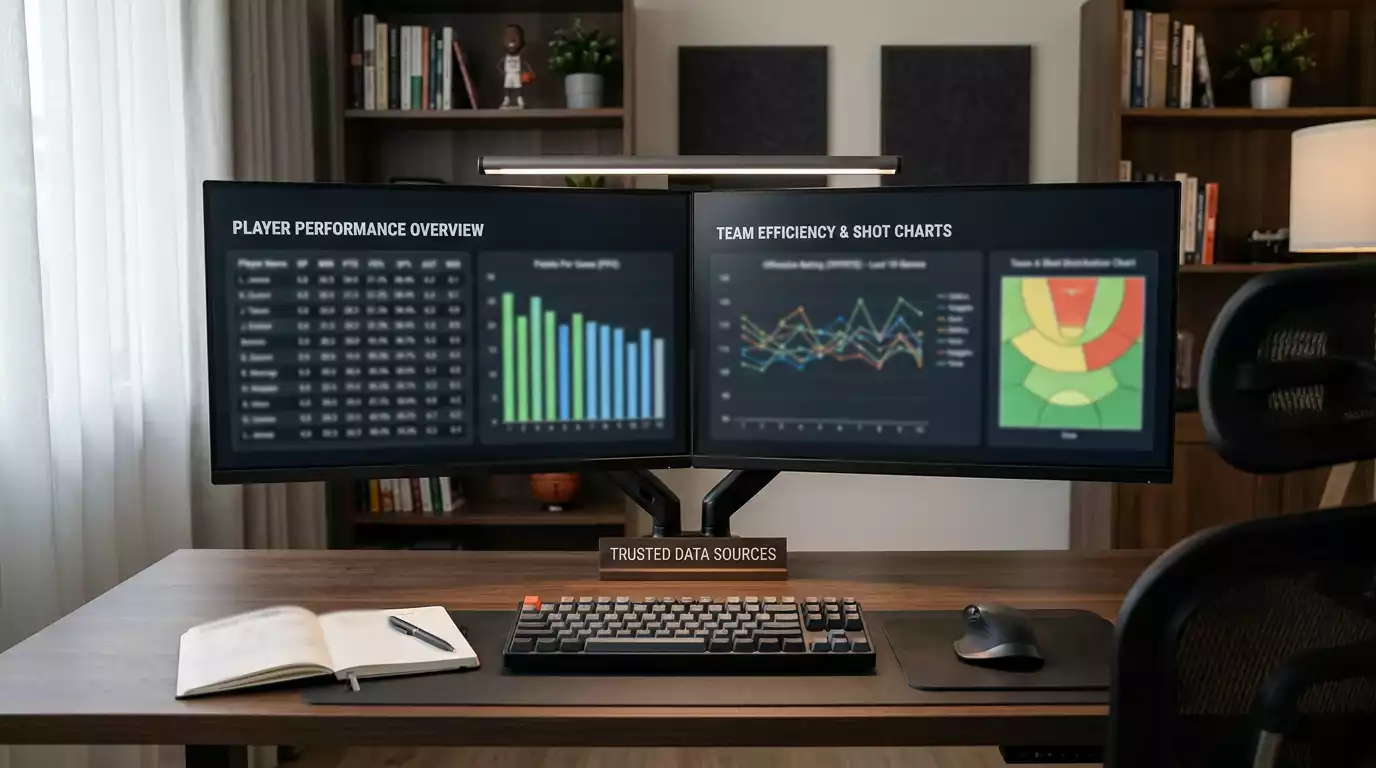
Basketball Reference is the single most useful free resource for NBA betting data. It has been the gold standard for basketball statistics for over a decade, and its depth is extraordinary: game logs for every player in every season, splits by home/away, by month, by opponent, and by rest days. I use it daily. The player game-log page is my starting point for any prop evaluation, because it shows the last 10-20 games in a compact table that I can scan for trends in minutes, shots, scoring and other counting stats.
NBA.com/stats is the official data source, and it offers several features that Basketball Reference does not. The player dashboard breaks down shooting by zone (paint, mid-range, three-point, corner three), which is invaluable for understanding how a player generates his points. The team stats section includes pace, offensive rating, and defensive rating — the foundational metrics for projecting game environment. The interface is clunkier than Basketball Reference, but the data is granular and updated in near-real-time during the season.
For quick pre-game checks, I use both sources in tandem. Basketball Reference for game logs and splits; NBA.com for shooting zone data and advanced metrics. Between them, I have everything I need to build a player-level projection for any prop market, without spending a penny.
Advanced Analytics Platforms: DvP, Pace, On/Off Data
Beyond box scores, the advanced analytics tier is where free data becomes genuinely powerful for prop betting. DvP tables — ranking each team by how much statistical output they allow to opposing players at each position — are available on Hashtag Basketball and FantasyPros. These tables are updated regularly and broken down by stat category (points, rebounds, assists, threes), which lets me target the specific prop market where the matchup advantage is strongest.
Cleaning the Glass is a premium site, but it offers a limited free tier that includes pace data, on/off splits for selected players, and four-factor data for every team. The four factors — effective field goal percentage, turnover rate, offensive rebounding percentage, and free-throw rate — are the building blocks of offensive and defensive efficiency. I use them to project team-level performance, which feeds into my game-total and player-prop models. The free tier is enough for directional analysis; the paid tier adds sample-size filters and lineup-specific data that I find useful but not essential.
On/off data — how a team performs when a specific player is on the court versus off it — is available on Basketball Reference’s advanced stats pages and on NBA.com. This data is critical for injury-cascade analysis: if a player’s on/off split shows that his team’s offensive rating drops by 6 points per 100 possessions when he sits, I know that his absence will suppress his teammates’ efficiency, which tempers the usage-boost effect on their prop lines. On/off data adds the efficiency dimension that pure usage-rate analysis misses.
Injury Reports and Schedule Feeds
The NBA tightened injury reporting rules in December 2025, requiring teams to submit updates at specific times with penalties for non-compliance. That change made the official NBA injury report — published daily on the league’s website and syndicated across major sports news platforms — more timely and reliable than ever. I check the report at two fixed points: 10:00 PM UK time (when the initial mandatory report for that night’s games drops) and again 90 minutes before each game I am considering betting.
For schedule data — upcoming back-to-backs, road trips, rest days — NBA.com publishes the full season schedule for every team. I download it at the start of the season and mark the back-to-back dates, long road trips, and games immediately following All-Star break or trade deadline. That calendar overlay is a permanent part of my analytical setup, and it takes about 30 minutes of work at the beginning of the season to prepare.
Odds Comparison and Line Movement Trackers
Free odds comparison tools let you see the same prop line across multiple UK sportsbooks simultaneously. These tools show you which operator offers the best price on the over, which offers the best price on the under, and how the line has moved since opening. Line movement data is particularly useful: a prop that opened at 22.5 and has moved to 23.5 without any public news suggests sharp money or informed action that you should factor into your decision.
I cross-reference line movements with the injury report and the social media accounts of NBA beat reporters, who often break news about player availability before the official report is updated. That combination of line movement data and information sourcing helps me understand whether a move is driven by information I should respect or by recreational money I can potentially fade.
The free data ecosystem for NBA prop betting has never been richer. Between box scores, advanced metrics, DvP tables, injury reports and odds comparison tools, a UK bettor can build a research process that rivals what professional operations used ten years ago — at zero cost. The constraint is not data availability. It is the discipline to use the data systematically rather than cherry-picking stats that confirm a pre-existing opinion. Building that discipline is the subject of the broader analytical framework described in the player prop bets guide.
What is the best free website for NBA player stats relevant to prop betting?
Basketball Reference is the most comprehensive free source for NBA player statistics. It offers game logs, splits by opponent and rest days, and advanced metrics updated daily. For shooting zone data and team-level metrics like pace and defensive rating, NBA.com/stats is the best complement. Together, they provide everything needed for detailed prop analysis at no cost.
Where can I track NBA injury reports in real time?
The official NBA injury report is published daily on the league’s website, typically available by 5:00 PM Eastern Time (10:00 PM or 11:00 PM UK time). Major sports news platforms syndicate the report. For faster updates, follow the verified social media accounts of NBA beat reporters covering the teams you are betting on — they often break injury news before the official report is updated.
Created by the ”nba Player Betting” editorial team.